Crypto-Agility Strategies: Decoupling Cryptographic Primitives from Payment Logic

- Hardcoding cryptographic algorithms in payment codebases creates severe technical debt and multi-month refactoring cycles during cipher deprecation.
- A Cryptographic Abstraction Layer (CAL) decouples low-level primitives from payment business logic using policy identifiers.
- Envelope encryption with metadata header tagging enables seamless key rotation and multi-cipher coexistence without database schema refactoring.
- Dynamic policy engines allow instant network-wide cipher disabling during emergency vulnerability disclosures.
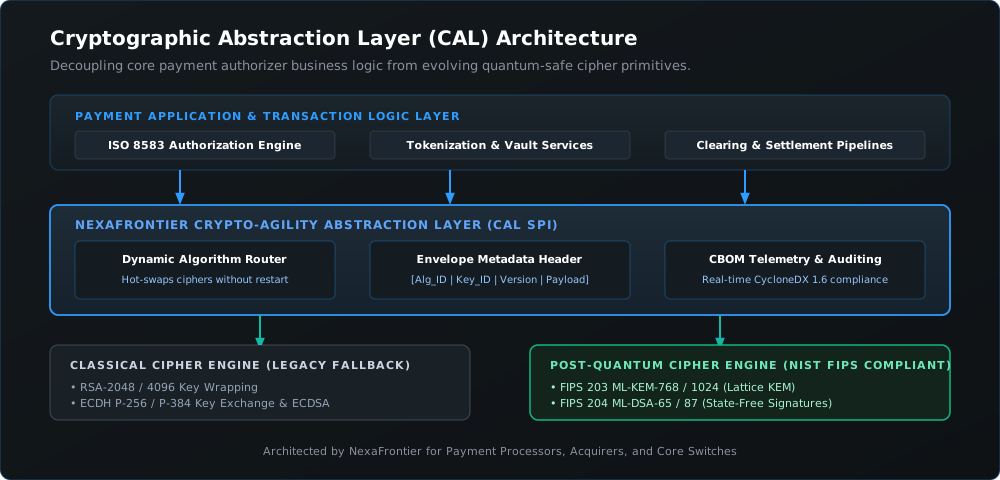
Crypto-agility is the ability to change algorithms, key lengths, and cipher parameters by configuration rather than by recompiling the authorization engine. For payment authorizers, the design that delivers it is a Cryptographic Abstraction Layer (CAL): business logic calls a policy identifier, the CAL resolves it to a primitive, and rotating an algorithm becomes a policy push instead of a multi-month refactor.
The Cost of Hardcoded Cryptography
Legacy fintech code often embeds algorithm choices directly. A Java service calls Cipher.getInstance("RSA/ECB/OAEPWithSHA-256AndMGF1Padding"), an ORM model hardcodes an AES mode, and an API client pins a certificate path. When NIST finalizes or revises a standard - FIPS 203 for ML-KEM, FIPS 204 for ML-DSA, and further signature work - every one of those call sites becomes a separate migration with its own regression surface. Across a distributed estate, that is months of change for what should be a configuration event.
What Crypto-Agility Means Precisely
Agility is not just having a wrapper function. It requires three properties: callers express intent rather than mechanism, encrypted data self-describes how it was protected, and a central policy can enable or disable primitives across the estate at once. Miss any one of the three and the abstraction is cosmetic.
The Three Components of a CAL
- Cryptographic service interfaces. Encryption, decryption, signing, and verification are exposed behind unified interfaces that accept a policy identifier, not a raw algorithm string.
- Envelope encryption with metadata tags. Every encrypted payload is prefixed with a header carrying key ID, algorithm ID, and version, so multiple ciphers coexist and rotation does not require a big-bang re-encryption.
- Dynamic policy engine. Cipher-suite allowlists live in one place, letting security officers disable a deprecated primitive across all services in an emergency without a code release.
Where the CAL Sits
The CAL belongs at the boundary between payment logic and the underlying cryptographic providers, not inside the routing engine. ISO 8583 field parsing, account validation, and fraud scoring should never import a cipher directly. In practice this means the CAL wraps PKCS#11 sessions, cloud key-management clients, and TLS libraries behind one interface, so an HSM firmware upgrade or a provider swap is invisible to the authorizer. The same interface carries the policy identifier that selects hybrid or pure post-quantum behavior, which is what makes the eventual FIPS 203 and 204 cutover a configuration event rather than a program.
Worked Example: Policy-Driven Cipher Selection
The table shows how the same calling code maps to different primitives as policy evolves. The calling service never changes.
| Policy ID | Key exchange or KEM | Signature | Symmetric | Status |
|---|---|---|---|---|
| LEGACY-2024 | ECDHE P-256 | ECDSA P-256 | AES-128-GCM | Deprecated, removal scheduled |
| CAGILE-v1 | ECDHE P-256 | ECDSA P-256 | AES-256-GCM | Preferred classical |
| PQ-HYBRID | X25519MLKEM768 | ML-DSA-65 (FIPS 204) | AES-256-GCM | Migration target |
| PURE-PQC | ML-KEM-768 (FIPS 203) | ML-DSA-65 (FIPS 204) | AES-256-GCM | Future, subject to peer support |
Note the size implication the CAL must absorb: an ML-KEM-768 public key is 1,184 bytes, which is 37x a 32-byte Ed25519 key. When a policy switch changes KEM families, the envelope header and any key store must already tolerate that growth; discovering it after a production push is how a latency incident starts.
Envelope Metadata in Practice
A minimal envelope header can stay compact and self-describing. The exact encoding is an implementation choice; the requirement is that old readers can still resolve old values while new writers emit new ones.
kid=pay-hsm-2026-07; alg=AES-256-GCM; wrap=X25519MLKEM768; ver=3
With this header, rotating to a new wrapping KEM is a matter of writing new envelopes while old ones remain readable. There is no requirement to decrypt and re-encrypt the entire store at once, which keeps the change inside a normal deployment window.
Rotating an Algorithm Without Recompiling
- Publish the new policy alongside the old one so both are valid.
- Enable the new primitive for new writes at the edge and in services.
- Backfill lazily. Re-wrap stored material on read or on a background sweep, using the metadata header to find old envelopes.
- Deprecate the old policy once the sweep completes and monitoring shows zero use.
- Remove the old primitive from the allowlist, which revokes it everywhere at once.
Anti-Patterns That Defeat Agility
- Policy identifiers that secretly map to a single hardcoded algorithm, so the abstraction is cosmetic.
- Envelopes without version headers, which force a big-bang re-encryption on every rotation.
- Per-service allowlists that drift independently, so emergency deprecation requires a fleet-wide rollout.
- Tests that assert a specific algorithm rather than a policy outcome, which freeze the primitive in place.
Measuring Agility
A useful maturity check is to ask how long it takes to move a single service from one KEM to another with no code change. The table frames the progression.
| Level | Change mechanism | Typical lead time |
|---|---|---|
| Hardcoded | Code change and regression test | Weeks to months |
| Wrapper library | Shared library upgrade and redeploy | Days |
| Policy-driven | Central configuration push | Hours |
Governance and Emergency Deprecation
The point of central policy is speed under pressure. When a primitive is deprecated after a disclosure, the response is a policy change that propagates to every service, monitored to confirm traffic has moved. That is the difference between a same-day mitigation and a multi-quarter program.
Key Takeaways
- Hardcoded algorithms turn every standards change into a distributed refactor.
- A CAL has three parts: intent-based interfaces, self-describing envelopes, and a central policy engine.
- Policy switches must account for size growth such as the 1,184-byte ML-KEM-768 public key, or 37x a 32-byte Ed25519 key.
- Central deprecation converts emergency cryptography changes into routine configuration pushes.
Frequently Asked Questions
Crypto-agility is the architectural capability to swap cryptographic algorithms, key lengths, and certificates via central policy and configuration without rewriting core transaction code.
By prefixing encrypted database records with lightweight metadata (Key ID, Algorithm ID, Version), authorizers can decrypt legacy RSA/AES ciphertext while writing new records with post-quantum algorithms.
It converts high-risk multi-year code refactoring projects into routine, zero-downtime configuration deployments.
Subscribe for Technical Briefings & PQC Advisories
Stay ahead of NIST FIPS standardizations, PCI DSS v4.0+ mandates, and quantum vulnerability disclosures.
Connect With Our Cryptographic Engineering Team
Discuss PQC migration strategies, HSM key lifecycle hierarchies, or schedule a fixed-scope Cryptographic Discovery Audit for your enterprise payment pipeline.

