Secure Your Payment Pipeline Against Quantum Threats.
The Cryptographic Mandate
Active Regulatory Urgency
Active PCI DSS v4.0.1 compliance (specifically Requirement 4.2.1.1 and Requirement 12.3.3, mandatory since March 31, 2025) now requires an auditable cryptographic inventory; a machine-readable CBOM is materially easier to evidence at assessment than a manual spreadsheet. Separately, the NSA CNSA 2.0 procurement gate for new National Security Systems acquisitions takes effect January 1, 2027 (NSS scope; commercial scheme deadlines follow later).
The HNDL Threat
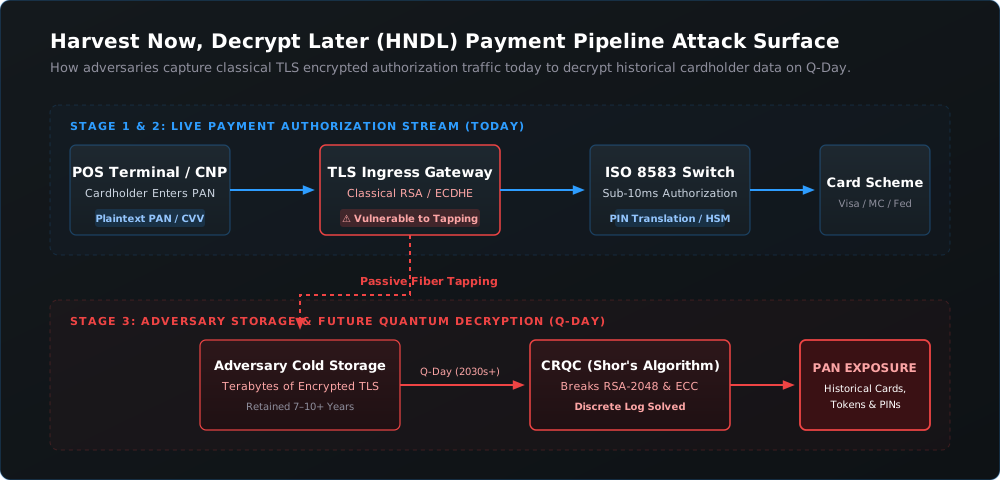
Under 'Harvest Now, Decrypt Later' (HNDL), state-sponsored adversaries and cyber syndicates are actively intercepting encrypted traffic traversing legacy TLS gateways and archiving authorization payloads. The moment cryptanalytically relevant quantum computers arrive, this stored historical PAN data will be decrypted retrospectively.
The Latency Trap
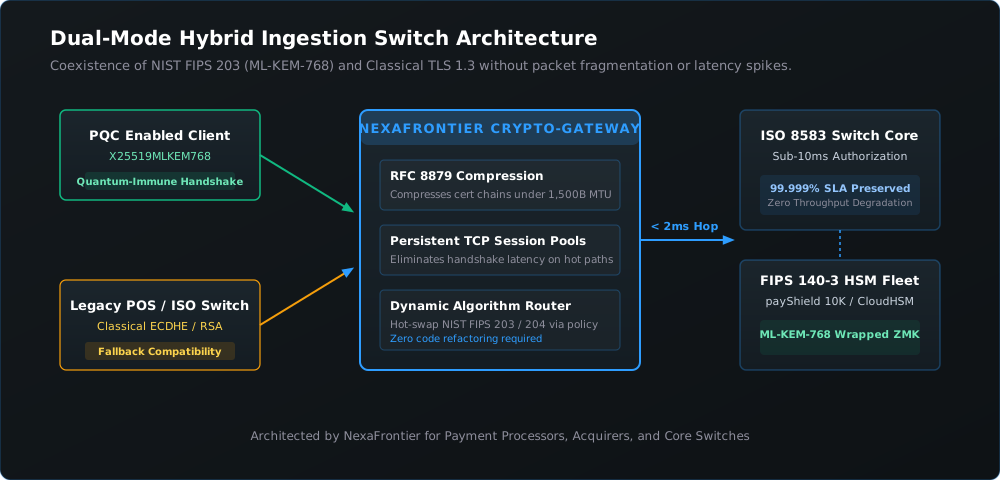
Migrating to NIST FIPS 203 (ML-KEM) introduces massive lattice-based payloads. Across high-throughput ISO 8583 payment authorizers handling tens of thousands of TPS, a 10ms handshake delay splits packets over 1,500-byte MTUs. This stalls TCP windows and breaks Visa and Mastercard scheme SLAs—triggering catastrophic timeout cascades and millions of dollars in lost interchange fees.
What We Do

Crypto-Agility Architecture
Decouple cryptographic primitives from payment logic to dynamically hot-swap post-quantum algorithms across transaction pipelines, HSMs, and API gateways without refactoring core systems.

Zero-Downtime Authorizer Migration
Architect dual-mode hybrid encryption pathways for high-throughput authorizers. Maintain sub-10ms transaction latency and 99.999% availability during phased quantum cryptographic upgrades.

NIST & PCI DSS Compliance
Future-proof transaction flows ahead of PCI DSS v4.0+ mandates with NIST-standardized quantum-safe algorithms: FIPS 203 ML-KEM for key encapsulation and FIPS 204 ML-DSA for digital signatures.
Interactive PQC Diagnostic Suite
PCI DSS v4.0 CBOM Readiness Scorecard
Assess your Cardholder Data Environment (CDE) across 8 critical dimensions including cipher lifecycles, key storage, and HNDL data retention windows to get an instant vulnerability rating.
ISO 8583 PQC Latency & MTU Packet Estimator
Model how NIST FIPS 203 (ML-KEM) and FIPS 204 (ML-DSA) key expansion impacts TCP packet fragmentation across standard 1,500-byte MTUs without risking sub-10ms authorization SLAs.
Research & Technical Briefings
Enterprise Engagement Profiles
MTU Packet Split Mitigation
Eliminated TCP multi-packet fragmentation in ML-KEM-768 handshakes, preventing 14ms latency spikes on high-volume authorizers.
Automated CDE CBOM Sprint
Illustrative: mapping a large microservice CDE to OWASP CycloneDX 1.6 with zero codebase access.
Zero-Downtime ZMK Hierarchy
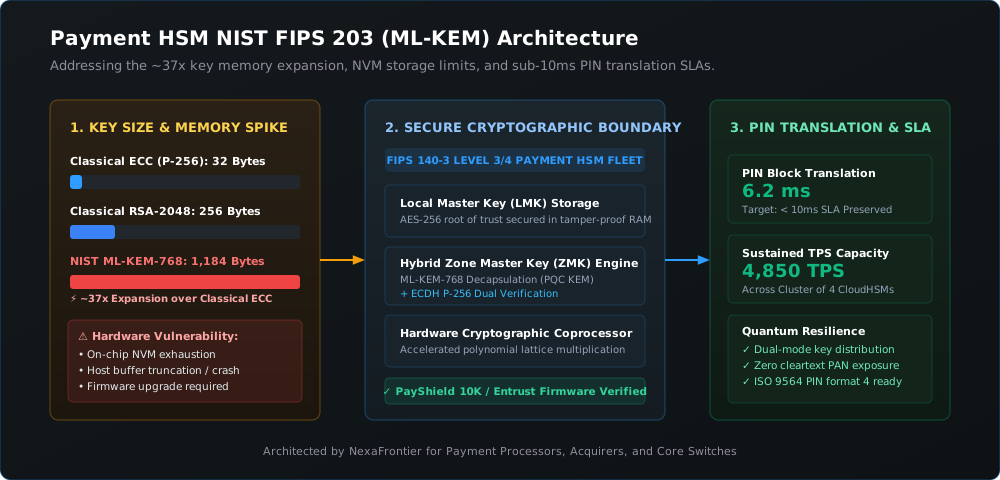
Prevented NVM buffer overflow in payShield clusters under 37x larger ML-KEM keyblocks during active PIN block translation.
Partner With NexaFrontier

PQC Advisory & Migration
Direct advisory and cryptographic engineering for payment gateways, card networks, and fintech infrastructure preparing for the quantum transition.
Book a Discovery Audit
Executive Threat Intelligence
Stay ahead of PQC migration timetables, NIST standardizations (FIPS 203/204), and PCI SSC cryptography guidance with our specialized technical briefings.

