Mitigating 'Harvest Now, Decrypt Later' (HNDL) in Payment Authorization Pipelines

- Harvest Now, Decrypt Later (HNDL) attacks intercept and archive encrypted cardholder traffic today, targeting retrospective decryption once Cryptanalytically Relevant Quantum Computers (CRQCs) emerge.
- Financial data retention mandates (7–10 years for PANs, authorization logs, and settlement data) make payment gateways and acquirers prime targets for state-backed harvesting.
- Dual-Mode Hybrid Key Encapsulation (X25519 + NIST FIPS 203 ML-KEM-768) provides immediate cryptographic immunity without breaking legacy client compatibility.
- PCI DSS v4.0 Requirements 4.2.1.1 and 12.3.3 mandate comprehensive cryptographic inventories across all CDE ingress endpoints.
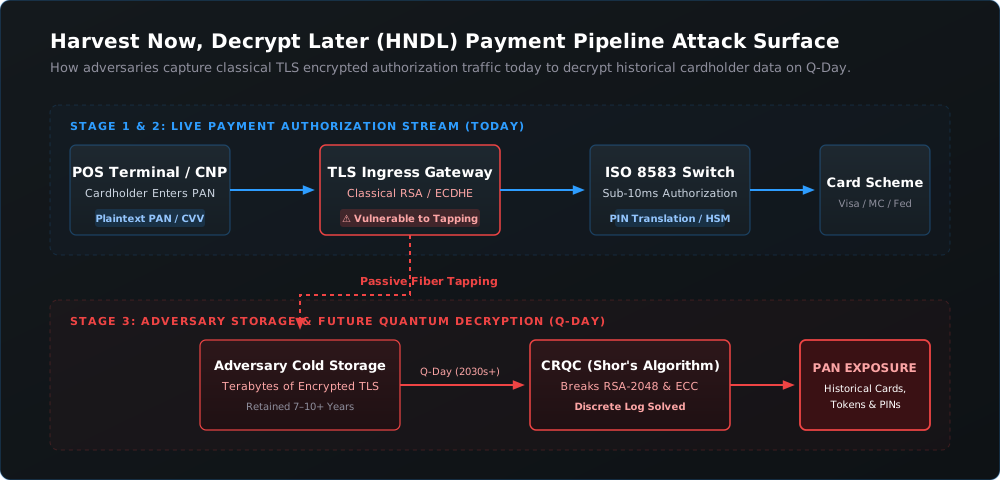
The Asymmetric Threat to Stored Financial Data
Adversary intelligence agencies and well-funded cyber syndicates are actively intercepting and storing encrypted payment streams across global fiber backbones. This attack paradigm—termed 'Harvest Now, Decrypt Later' (HNDL)—exploits the fundamental reality that while today's RSA-2048 and ECC secp256r1 ciphers remain unbroken by classical supercomputers, they will collapse instantly once Cryptanalytically Relevant Quantum Computers (CRQCs) materialize running Shor's algorithm.
For payment processors, acquirers, and point-of-sale tokenization vaults, the impact is catastrophic: credit card PANs, biometric payment tokens, and recurring billing secrets that require 7-to-10-year data retention are being archived right now. When decrypted retrospectively, entire card portfolios and historical clearing records will be exposed.
Defensive Remediation: Hybrid Key Encapsulation
To mitigate HNDL immediately without waiting for complete ecosystem-wide quantum transition, payment enterprises must deploy Dual-Mode Hybrid Key Exchange (X25519 + ML-KEM-768) on all transport layer endpoints. By combining an established classical elliptic curve with NIST FIPS 203 (Module-Lattice-Based Key-Encapsulation Mechanism), an adversary must break both cryptographic primitives simultaneously to decrypt the captured session.
Key Takeaways for Payment Architects:
- Audit all TLS termination points across API gateways, webhook dispatchers, and ISO 8583 ingestion nodes.
- Identify long-term encrypted data stores holding cardholder data (CDE) and prioritize post-quantum re-encryption.
- Implement crypto-agile wrapper libraries that allow seamless migration to pure ML-KEM as client support broadens.
Frequently Asked Questions
Adversaries are capturing and archiving encrypted transport streams right now. Because payment authorization records, PAN data, and tokenization keys must be retained for 7 to 10 years for regulatory and dispute reconciliation, data stolen today will be decrypted retrospectively the moment quantum computers mature.
Deploying Dual-Mode Hybrid Key Exchange (X25519 + ML-KEM-768 / FIPS 203) on all transport layer endpoints. This combines proven elliptic-curve security with lattice-based post-quantum cryptography, requiring an attacker to break both algorithms simultaneously.
While PCI DSS v4.0 does not explicitly specify post-quantum cipher names, Requirement 4.2.1.1 and 12.3.3 strictly mandate that entities maintain an active Cryptographic Bill of Materials (CBOM) and proactively track cipher lifecycle risks ahead of deprecation.
Subscribe for Technical Briefings & PQC Advisories
Stay ahead of NIST FIPS standardizations, PCI DSS v4.0+ mandates, and quantum vulnerability disclosures.
Connect With Our Cryptographic Engineering Team
Discuss PQC migration strategies, HSM key lifecycle hierarchies, or schedule a fixed-scope Cryptographic Discovery Audit for your enterprise payment pipeline.

